When you buy through links on our articles, Future and its syndication partners may earn a commission.

For the first time in more than 50 years, humans are cruising through lunar space.
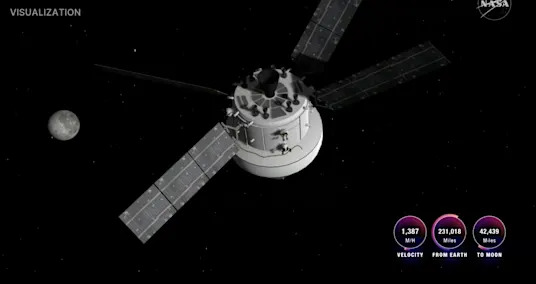
The four astronauts of NASA's Artemis 2 mission arrived in the moon's sphere of influence — the region where lunar gravity exerts a more powerful pull than that of Earth — today (April 6) at 12:37 a.m. EDT (0437 GMT).
The milestone occurred when the mission's Orion capsule was about 39,000 miles (62,764 kilometers) from the moon and roughly 232,000 miles (373,368 km) from Earth, a commentator said during NASA's Artemis 2 livestream.
The Artemis 2 astronauts — NASA's Reid Wiseman, Victor Glover and Christina Koch and the Canadian Space Agency's Jeremy Hansen — are the first people to cross the lunar threshold since December 1972, when the three-person Apollo 17 moon-landing mission did so.
Artemis 2 will not touch down on the moon, or even enter lunar orbit. Rather, Orion will loop around the moon's far side this evening in a history-making flyby. During that encounter, Artemis 2 will get farther from Earth than any crewed flight ever has.
The distance record is currently held by the Apollo 13 astronauts, who got 248,655 miles (400,171 km) from our planet in April 1970. At the height of tonight's flyby, just after 7 p.m. EDT (2300 GMT), Artemis 2 will be 252,757 miles (406,773 km) away from the rest of humanity, NASA officials have said.
The Artemis 2 astronauts will study the moon during the flyby, gathering data that could help scientists better understand the terrain and geology of Earth's nearest neighbor. They'll also be treated to a total solar eclipse, which will not be visible to those of us here on terra firma.
In addition, the flyby will chart their path home: Lunar gravity will slingshot Orion back toward Earth. Artemis 2 astronauts will come home on Friday (April 10), ending their 10-day mission with a parachute-aided splashdown off the coast of San Diego.
Editor's note: This story was updated at 1:15 a.m. EDT on April 6 with NASA's revised time of Orion's entry into the moon's sphere of influence — 12:37 a.m. EDT rather than 12:41 a.m. EDT.
LATEST POSTS
- 1
 The Starbucks for Life game is back, along with your chance to win a 'Bearista' cold cup. Here's how to get your paws on one.
 - 2Gaza receiving over 70,000 cubic meters of water per day, COGAT claims
- 3Top 15 Web-based Entertainment Stages for Individual Marking
- 4German official report: Teen social media ban faces legal hurdles
- 5Cyber Monday 2025: Save over 70% on HBO Max with this Prime Video streaming deal





- Find the Excellence of Old style Expressive dance: Encountering the Effortlessness and Polish of Dance
- Shrapnel hits across central Israel, injuring several, causing property damage
- Savvy Watches: Which One Is Appropriate for You?
- Netflix's Eddie Murphy documentary explains 'Saturday Night Live' beef: 'That's why I didn't go back for years'
- Inflammatory Merz remarks on migrants' violence against women slammed
- Significant Elements to Consider Prior to Applying for a Mastercard: 6 Vital Contemplations
- Paraplegic engineer becomes the first wheelchair user to blast into space
- How Would You Like to Deal with Your Funds?
- Taylor Swift's 'The End of an Era' docuseries: Everything you need to know, plus how to watch for less